
A Domain Lock (also called a registrar lock) is a security setting that prevents your domain name from being transferred to another provider or modified without your authorization. When enabled, it acts as a digital safety lock on your domain.
|
Security Features |
|
|
What It Does Not Affect |
|
Steps to Lock and Unlock Your Domain
If your domain has Domain Lock enabled, you will need to unlock your domain if you want to make DNS modifications or transfer your domain to another 101domain account or to another Registrar. Once you are done, you will need to re-enable the Domain Update Lock.
-
Select the Domain Names tab.
-
Select the domain you wish to lock or unlock.
-
Within the Domain Quick Overview section, select the Domain Update Lock.
Some ccTLDs may follow different registry lock protocols. If this option is not available, a note will be displayed under Domain Update Lock that says “Unavailable for this domain.”
-
Select Enabled or Disabled.
-
Enter the answer to the displayed security question.
If you do not know the answers to your security questions, please complete our online Account Recovery form and our Support team will assist you with retrieving the answers.
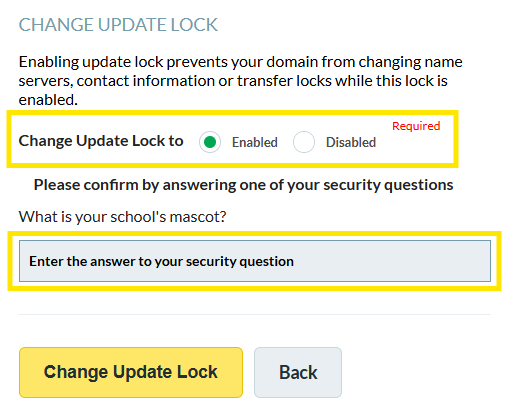
-
Click on Change Update Lock.
Common Types of Domain Locks
|
Lock Type |
Description |
|
Registrar Lock (ClientTransferProhibited) |
The standard lock enabled by default in your domain control panel. You can easily toggle it off yourself when you actually want to transfer your domain. |
|
Registry Lock (ServerTransferProhibited) |
An enterprise-grade layer of security applied at the top-level registry (e.g., Verisign for |
|
ICANN 60-Day Lock |
An automated policy lock that temporarily blocks transfers for 60 days after registering a new domain or making major updates to registrant contact details. |
If you need further assistance, please contact our Support Team.